Website SEO Report: Global Scaling Engine for Brands | Pella Force | Pella Force
Website SEO Report as a Global Scaling Engine: What Brands Must Know in 2026
Posted 4/24/2026
14 min read
A
By Atul Lohar
Website SEO Report as a Global Scaling Engine — What Brands Must Know to Win in 2026
Setting the Stage
Knowing the website’s performance, technical health, visibility, traffic and user engagement is crucial to run and scale a brand in 2026. Through a structured website SEO report, we assist brands in mapping and understanding marketing strategies to boost website traffic, conversions, ROI, and their online presence. Pella Force curates tailored reports for diverse brands. With keyword rankings and quality of backlinks, we optimise websites to improve visibility, ranking and conversions. Ready to be part of this digital transformation? Here’s a detailed snapshot.
Misconceptions about Website SEO Report
Before we dive deep into the concept, some myths and misconceptions need to be cleared up for clarity and a comprehensive understanding.
Website SEO is one-time
Website SEO is a regular phenomenon. As competitors constantly upgrade their strategies and search engine algorithms keep changing, regular website performance analysis is a must for all brands.
Ranking is End of All
Ranking is one of the metrics of performance. Other performance indicators might overpower ranking. So, brands facing high traffic flow often get poor ROI and conversions.
All Backlinks are Beneficial
Many studies show that a high volume of new, low-quality links can impact rankings.
Social Media has Zero Impact
Social media and rankings are independent factors. Yet, social media is a powerful tool in website SEO as it boosts visibility and drives traffic.
Components of Website SEO Report: The Nine Mandatory Sections
A comprehensive website SEO report typically encompasses a few important sections that cover all the nitty-gritty of a website’s health and functionalities. Pella Force generates well-structured and tailored reports, and here’s what it includes.
1
Executive Summary
This is a snapshot of the key performance indicators. In this section, we highlight what’s Working, what’s Growing and what Needs improvement.
2
Traffic and Performance Analysis
We assess trends and sources of organic traffic, user behaviour and engagement.
3
Keyword and Ranking Visibility
We specialise in tracking placement and ranking of target keywords and monitor the reach and visibility.
4
Technical SEO Audit
Our assist brands to analyse the site’s technical health, crawl glitches, page speed and technical audit service, functionalities, HTTPS status, and mobile responsiveness.
5
On-Page SEO
In this section, Pella Force strategically includes keyword consistency, content quality, meta titles, descriptions and image alt text, and internal linking framework,
6
Off-Page
This part is for review of the quality and quantity of backlinks. The domain authority, and the acquired new links are also highlighted.
7
Conversions
We set up links and connect business goals with SEO traffic. This part includes the dynamics of conversions, ROI and revenue generation.
8
Competition Analysis
We keep a track of the close competitors and reform and redesign the marketing strategies.
9
Action Plan
This section is for a realistic, smart and measurable action plan for the brand, to scale globally in 2026.
Technical SEO- The Backbone of a Website’s Performance
The process of optimising the technical functionalities of a website is referred to as technical SEO. This is mainly to increase its search engine rankings. We focus on the coding functions, crawlability and indexing to ensure smooth running of the website's architecture.
Pella Force uses its expertise to make the website easier to find in the search engines. We also focus on user experience and engagement, and the mobile-responsive framework of a website.
Key Components of Technical SEO
Crawlability: We ensure robots, such as Googlebot, can seamlessly access the content of the website. We empower brands to manage sitemaps to assist crawlers.
Site Architecture: Here, we create a logical structure with accurate internal linking that assists bots in navigating and understanding the content structure, layout, hierarchy and design.
Page Speed: Pella Force generates a page speed and technical audit report to optimise the website functions.
Mobile-Friendliness: We ensure the site works uninterruptedly on mobile devices.
Security (HTTPS): We embed SSL certificates, driving the security of the website.
Structured Data (Schema Markup): We use codes and guide search engines to understand the context and generate distinct results.
On Page SEO: From Content to Conversions
The process of optimising elements on a specific page of a website is what we call on-page SEO. Also referred to as on-site SEO or on-page optimisation, we regulate elements like keyword optimisation, user engagement, meta titles and descriptions. At Pella Force, search engines understand and map the quality of the content, improving ranking and boosting usability.
Key Components of On-Page SEO
Content Quality and Structure
We follow the E-E-A-T strategy which breaks down to Experience, Expertise, Authoritativeness, Trustworthiness. This is to create original and rich content.
Meta Titles
Pella Force creates unique and SEO-enriched meta titles. This is the primary clickable headline, found in the search results. We ensure, the primary keyword is placed at the beginning of the meta title.
Meta Descriptions
Going by the nomenclature, this is a brief summary of the content. Written within 160 characters and with the primary keyword, this drives clicks and web traffic.
Header Tags
We use header tags to structure the content boosting readability and presentability. H1- the main title H2 and H3- Sub-headings
URL Structure
This is simple and readable web addresses embedded with keywords, that assist both visitors and search engines in comprehending the intent of the website page.
Image Optimisation
We recommend to use descriptive filenames and Alt text to make search engines understand the visual content seamlessly.
Page Experience and Performance
Through our on-page SEO analysis, we empower businesses to optimise loading time and mobile-responsiveness.
Backlink Profile- The Guide for Off-Page SEO
A backlink profile is the cluster of all the external links connected to the website. Comprising quality, relevance, quantity, and anchor text of these links, these off-page SEO or backlink profile elements are used to measure authority and determine search rankings.
High-quality backlinks boost the website’s ranking in all the leading search engine result pages.
Good-quality links are effective in driving web traffic and targeting the brand website.
A spectrum of strong links ensures the credibility and trustworthiness of the website.
Key Components of Backlink Profile
Quantity and Authority: This is the measure of the total number of links and the strength of the websites linked with the business.
Relevance: Through relevance, we refer to the links from the sites within your niche. These are more powerful and structured than random links.
Anchor Text: This is the clickable text of a link, which ideally appears organic and varied.
Diversity: A healthy website contains links from a variety of high-authority domains instead of many links from one particular site.
Evaluate and Benchmark: Pella Force Decodes Competitors to Define Your Edge
Pella Force specialises in the competitor’s benchmarking process. As a part of the website SEO report, we measure the site’s SEO performance against the close competitors. From the strengths and flaws to the areas of improvement, we analyse every aspect to boost the visibility, online strength, and marketing strategies. We even benchmark data-driven metrics
like traffic, backlink quality and keyword rankings to understand where the brand stands.
Through the extensive competitor SEO analysis, we identify which keywords they rank for to bridge the content difference.
We identify rank-boosting opportunities by assessing the quality and quantity of the sites linked to your client and their competitors.
Pella Force also evaluates the quantity of organic traffic for the competitor’s site and identifies the channels driving the traffic.
We compare the comprehensive credibility and authority of the site against the domain competitors.
Easy Ways to Interpret Website SEO Report Like a Pro
Our website SEO report is easy to read, follow, and interpret for people with zero technical knowledge. Move away from technical jargon and focus on the core factors driving business growth. Here are some quick tips.
Check the key metrics and compare them against month-over-month and year-over-year data. This will depict clarity and the real SEO performance.
Assess the flow of organic traffic by seeing the number of visitors coming from search engines. It is important to see if the number is rising.
You can check the keyword ranking and evaluate if your keyword is moving to the top searches.
Evaluating the conversion ratio is also important. It is a crucial way to measure the number of visitors who are getting converted and engaged in the buying process.
Checking mobile-responsiveness is also vital. Mobile design is a key element to assess the website’s SEO, as most of the searches happen on mobile screens. You must make sure that the look and feel and functionality of the site work seamlessly.
Most importantly, site speed is also crucial. If the page loading is slow, traffic leaves and search engines rank you lower.
The SEO Report Reality Check
Do you know about the misinterpretations or red flags in your website performance analysis that often mislead the users? Take a quick look.
All Good Things
If the report only highlights the positive metrics showing increased traffic and growth and covers up declining indicators.
Extra Highlight
If there is an over-emphasis on high-ranking zero volume keywords, domain authority or impressions.
Glitters and Glamour
If every website audit report portrays only gains instead of setbacks and algorithm updates, the reporting is misleading.
Inconsistency
When one is tracking different metrics every month to cover up inconsistent progress.
Ineffective Traffic
When you consider traffic coming from social media and paid ads as organic traffic.
Unproductive Conversions
There can be reports that indicate boost in traffic yet very low conversions.
Poor Visibility on Technical SEO
A website SEO analysis report is half-baked if there is no clarity and visibility of site speed, technical glitches and mobile responsiveness.
Wrap Up
The comprehensive overview of the technicalities, site’s health, ranking, visibility and conversion is portrayed through a structured website SEO report analysis. The reports clearly indicate increased volume of organic traffic, ROI, an increase in conversions, and a boost in search rankings and overall performance. Pella Force specialises in curating well-structured website SEO reports, tailored for different brands. We indicate keyword opportunities, technicalities, competitor strategies and clear insights to boost and build site authority. If you are thinking about analysing the brand’s website to optimise its ranking, visibility and performance, there is nothing better than Pella Force.
FAQs
Can slow page speed affect a site’s rankings?
Yes, it does. Slow page speed upsets users, and they eventually leave the site, pulling down the search engine ranking of the website.
Why is competitor analysis included in a website SEO report by Pella Force?
Pella Force includes competitor analysis in a website SEO report to understand and benchmark the strengths and flaws of the competitors. It also assists in comprehending your areas of improvement.
Are all backlinks good for a website?
Only high-quality, relevant backlinks benefit your website. It is important to have good quality instead of high quantity. A few strong, relevant links can outplace several low-quality ones.
How often should I check my SEO report?
Website SEO analysis is not a one-time activity. Brands need to run the analysis and check the report regularly to identify trends, glitches and areas of improvement.
Ranking #1 on Google is the ultimate goal for brand websites. A Myth or Reality?
Ranking #1 on Google as the ultimate goal for brand websites is a myth. Ranking high is crucial and advantageous, yet sales conversions and business revenue are the real metrics for boosting performance.
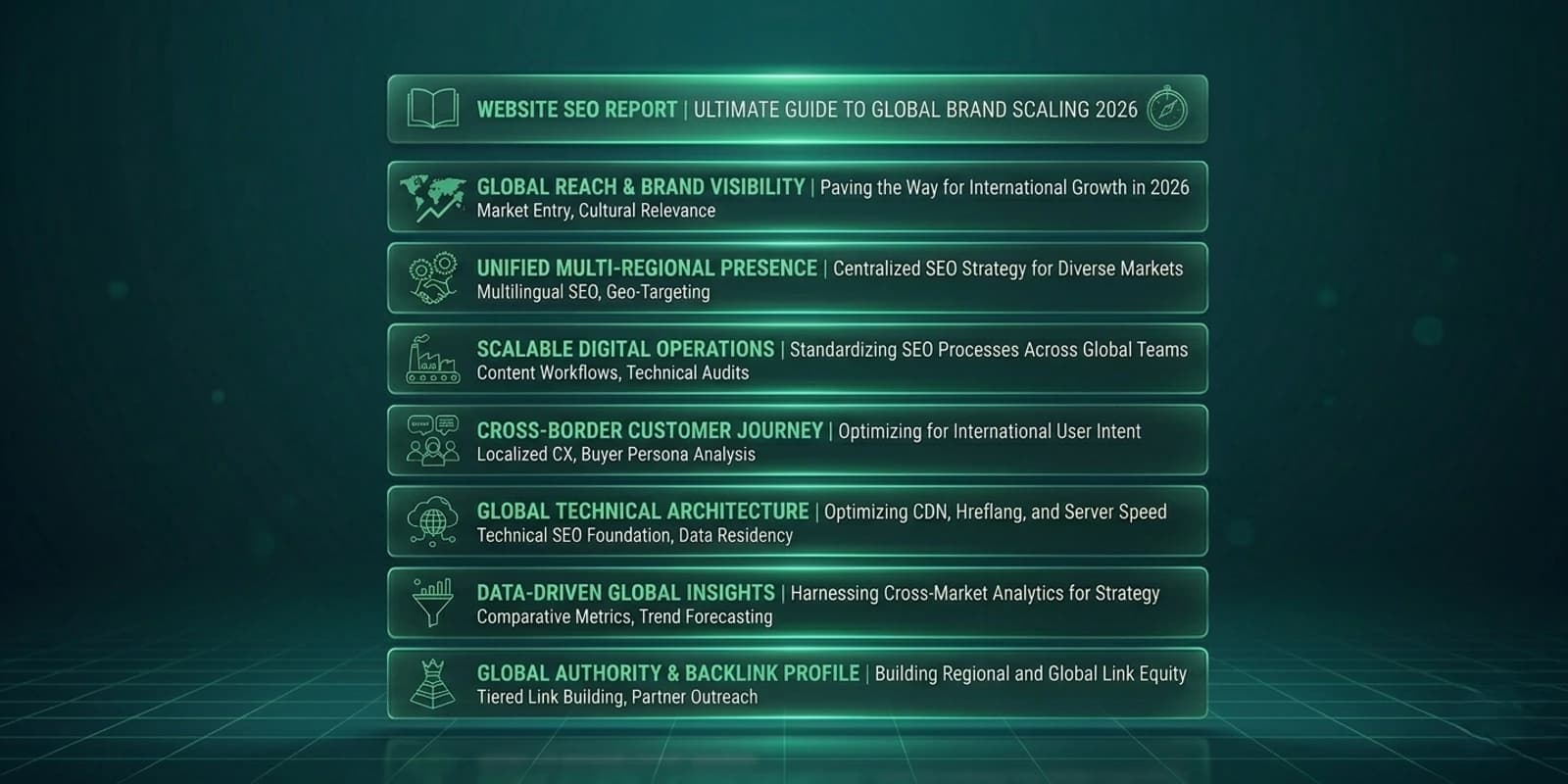
What is a Website SEO Report and Why Is It Essential for Global Brand Scaling in 2026?
A website SEO report is a comprehensive audit document that analyzes a brand's search visibility, technical health, content performance, and backlink profile. In 2026, it is essential for global brand scaling because it:
Identifies critical ranking gaps across international markets
Benchmarks performance against global competitors
Guides AI-ready content strategies for Google AI Overviews and LLM citations
Uncovers multilingual keyword opportunities and geo-targeted SEO priorities
Supports data-driven decisions that accelerate worldwide organic growth
What Are the Key Components of an Ultimate Website SEO Report in 2026?
A complete website SEO report in 2026 includes the following core components:
Technical SEO audit — Core Web Vitals, crawlability, indexation, and site speed
On-page analysis — H1–H6 structure, meta titles, descriptions, and keyword alignment
XML sitemap and robots.txt optimization — Ensuring correct indexation signals globally
Structured data implementation — FAQPage, BreadcrumbList, and LocalBusiness schema
Mobile-first optimization — Critical for ranking in mobile-dominant international market.
How Does an SEO Report Guide a Global Content Strategy Using Pillar Pages and Topic Clusters?
An SEO report maps content gaps and opportunities to build a scalable global content architecture:
Identifies missing pillar pages for core service or product categories
Reveals keyword clusters to support topic authority across international markets
Highlights thin or duplicate content that undermines semantic relevance
Prioritizes content types — blogs, FAQs, landing pages — by traffic and conversion potential
Aligns topic clusters with AI search query patterns for LLM citation eligibility
Why Is E-E-A-T Critical in a Website SEO Report for Building Global Brand Authority in 2026?
E-E-A-T (Experience, Expertise, Authoritativeness, Trustworthiness) is Google's quality framework and a key factor in AI citation selection. An SEO report evaluates E-E-A-T by:
Auditing author bio pages and credentials across all published content
Checking for editorial review processes and publication transparency
Analyzing backlink authority from high-trust, industry-relevant domains
Reviewing brand mentions across the web and AI platforms
Ensuring factual accuracy, citation sourcing, and schema-backed trust signals
What Are the Best Tools and KPIs to Measure Website SEO Report Success for Global Brands?
Top tools and KPIs to track in a global SEO report include:
Tools: Google Search Console, GA4, SEMrush, Screaming Frog, Ahrefs
KPIs to Monitor:
Organic traffic growth by country and language segment
Featured snippet impression share and PAA appearances
Core Web Vitals scores across device types
Domain Authority and backlink velocity
AI Overview citation frequency and brand mention volume on LLM platforms
How Does Investing in a Website SEO Report Deliver ROI for Brands Scaling Globally in 2026?
A website SEO report delivers measurable ROI by:
Reducing paid ad spend through improved organic visibility in target markets
Increasing qualified international traffic via geo-targeted keyword optimization
Improving conversion rates by fixing UX and technical issues uncovered in the audit
Accelerating AI search citations that build brand credibility without additional media spend
Creating a replicable global SEO framework that scales across new markets and product lines.