Website SEO Analysis by Pella Force: Business Owner's Global Guide 2026 | Pella Force
Website SEO Analysis: A Business Owner's Step-by-Step Guide to Dominating Global Search Performance in 2026
Posted 4/28/2026
14 min read
A
By Atul Lohar
Website SEO Analysis: The Complete Business Owner's Guide to Understanding Your Global Search Performance in 2026
Understand Your Search Performance: A Simple 2026 Guide to Website SEO Analysis
Website SEO analysis is a complete health check for your online presence. It involves auditing your site to find troubles that stop search engines from ranking you. It looks at technical errors, content quality and competitor strategies. By fixing these things, you improve your visibility. This leads to more traffic, more leads and more sales.
For business owners in 2026, it is the most important step to ensure your website is working as hard as your team. Your website is your best employee. It works for you 24 hours a day, 7 days a week. Does it actually do its job? A website that does fail to rank on Google is of no use for your business. No one knows it exists.
Pella Force can assist you to get the top position on search engines at affordable rates. Search algorithms are smarter than ever now in 2026. They check the user experience, page speed and useful content. OurSEO analysis report is something you should consider to take your business forward successfully.
This guide is mainly for business owners apart from technical experts. In this blog, you will know what website SEO analysis means, why it matters and the five specific types of analysis you need. By the end of this guide, you will know exactly how to turn your website into a growth engine.
What Website SEO Analysis Means and Why It Matters For Global Business Growth in 2026?
Many business owners think that SEO is simply about keywords. However, that is absolutely wrong to think. Website SEO analysis is the act of looking at the data behind your site. It is the root cause analysis for your online performance.
Why does this matter for global business growth in 2026? Competition is very high now. Every day, your competitors keep on updating their sites and improve their technical health. There is no meaning to stand still otherwise you will stay backward.
Our search visibility analysis assists you to see where you are winning and where you are losing as it turns guesswork into strategy. When you understand your search performance, you can stop wasting money on marketing that is of no use. Then, you will stop creating content that nobody reads. You will start focusing on the exact factors that drive real growth.
The 5 Types of Website SEO Analysis Every Business Needs
You should look at your website from five different angles to succeed in 2026. Each type of our search intent analysis tells a different part of the story.
Type of Analysis
Focus Area
Why It Matters
Technical
Site health, speed and crawling
When Google is unable to find your site, it fails to rank it.
On-Page
Keywords, titles and headers
Assists Google understand what your page is about.
Off-Page
Backlinks and authority
Informs Google that other sites trust you.
Content
Gaps, quality and relevance
Keeps users engaged and happy.
Competitor
Competitive strategies
Shows you how to beat them.
Technical SEO Analysis
Technical SEO is the foundation of your website. Our technical SEO audit checks how Google crawls your site.
Site Speed: Does your page load in under two seconds? Slow sites lose visitors instantly.
Mobile Friendliness: Most people search on phones. So it is important to check whether your site is easy to use on a small screen?
Broken Links: Do you have "404 Error" pages? These things frustrate users and hurt your rankings.
Indexing troubles: Is Google actually including your pages in its search results?
This part of the analysis controls whether Google can even see your site. You must fix these technical troubles before doing anything else.
On-Page SEO Analysis
Once your site is healthy, you should look at individual pages. On-page SEO analysis ensures that your content talks to Google in the right language.
Title Tags: Does each page have a unique, descriptive title?
Meta Descriptions: These are the short previews in search results. Are they written to encourage clicks?
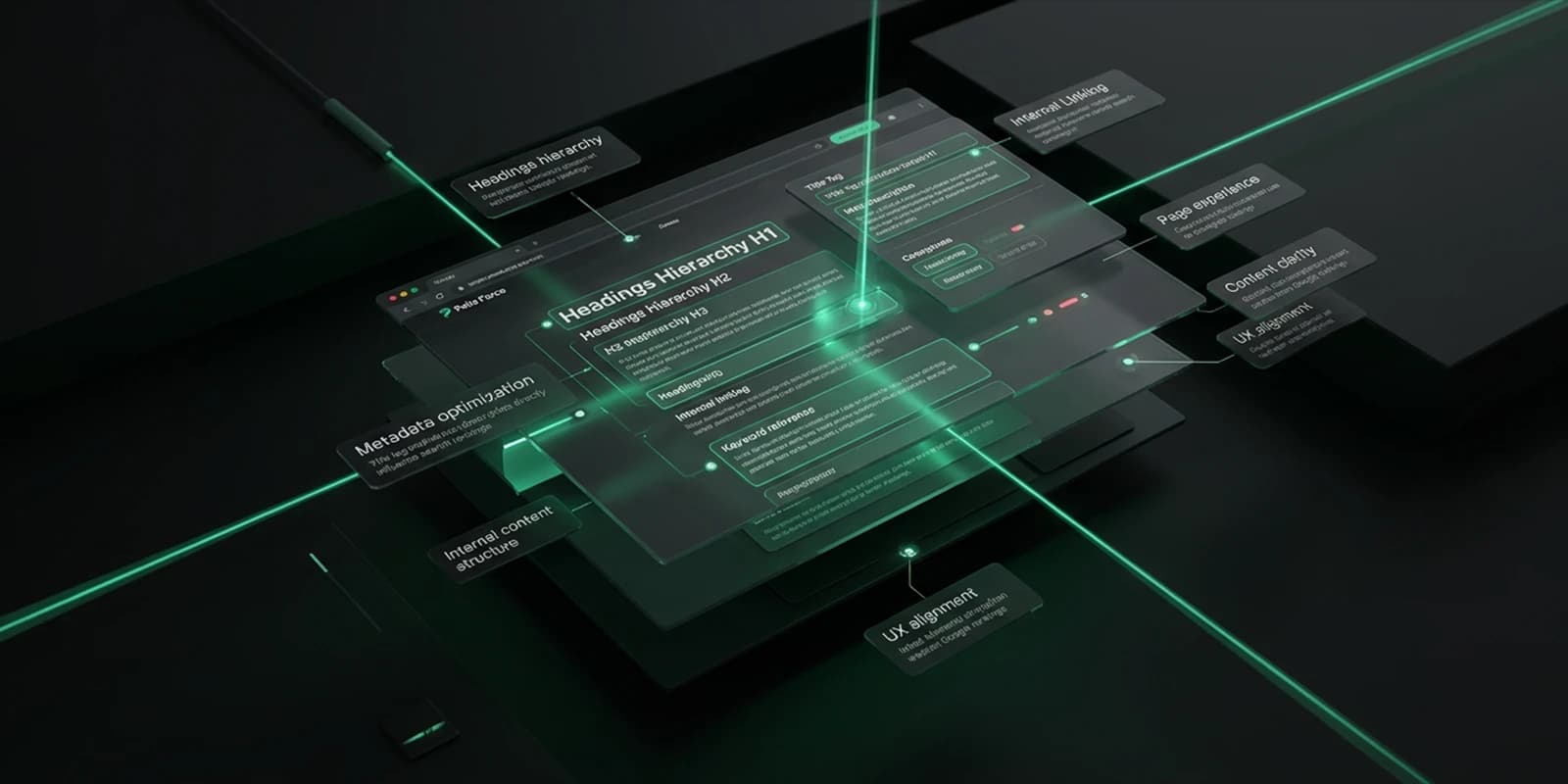
Header Tags: Are you using H1, H2 and H3 headers to organize your text? This assists both people and bots to read your page.
Keyword Placement: Are you using relevant keywords naturally or are you simply stuffing them in?
These elements directly affect your ranking positions. Small tweaks here often lead to big jumps in visibility.
Off-Page SEO Analysis
Off-page analysis looks at your reputation on the internet. Google views other websites linking to you as votes of confidence in 2026.
Backlink Quality: Are high quality competitive sites linking to you? Or are they spammy, low quality sites?
Brand Signals: Are people searching for your brand name by itself? This shows Google you are a known entity.
Anchor Text: What words are other sites using when they link to you? It should look natural.
This analysis assists you understand your Domain Authority. It is a long term game that builds trust over time.
Content SEO Analysis
Finally, you must look at your content. Is it benefiting your business or is it taking up space?
Content Gaps: Are your competitors writing about topics you are ignoring?
Underperformers: Do you have pages that get zero traffic? You might need to update or delete them.
High Opportunity Pages: Do you have pages ranking on "Page 2" of Google? These are easy wins. A little update can move them to Page 1.
This analysis ensures that your content strategy is tied to actual business goals.
How to Prioritize Website SEO Analysis Findings?
You will find many great ways to improve your site. Simply focus on one step at a time to make steady progress. Prioritize by business impact rather than technical severity.
Fix Critical Errors First: When your site is down or non-indexed, fix that immediately.
Quick Wins: Look for pages that are close to ranking on Page 1. Give a small update to move them up quickly.
High Value Pages: Which pages generate the most money? Optimize these first.
The "Ignore" Pile: When a technical error affects a page that gets zero traffic and gives no value, leave it for later.
Always ask "Will fixing these make me more money or get me more leads?" When the answer is no, put it at the bottom of your list.
What PellaForce Independent Website SEO Analysis Process Delivers?
Many agencies deliver standard SEO audits. They give you a generic and automated report with hundreds of technical errors. This is usually confusing and useless for a business owner. However, we do things differently as we focus on the business result. Our independent website SEO analysis process delivers which are as follows:
Human Readable Insights: We convert technical jargon into plain English so that you will know exactly what matters and why.
Impact-First Strategy: We tell you about the specific order to fix them to make you get the fastest return on investment.
Competitive Intelligence: We look at your competitors along with your website check. We show you exactly how to attract the traffic they are currently getting.
We act as an extension of your business which focuses on the growth that actually matters to your bottom line.
Conclusion
Website SEO analysis is a process to check, learn and improve. By knowing your technical health, your content quality and your competitors, we assist you to rule your market. Start your SEO gap analysis today with us to find the gaps in your marketing strategy. So contact the PellaForce team today for a business focused SEO audit that gives you real growth.
FAQs
What is website SEO analysis and why does it matter in 2026?
Think of website SEO analysis as a regular health checkup for your website. It looks at your site's technical health, the quality of your content and how well it performs. This is critical in 2026 as search engines (like Google) have become smarter. They prioritize sites that are trustworthy and ready for AI search tools. A regular checkup keeps your site fast, easy for Google to read and relevant to what people are actually searching for.
How does a technical SEO audit support my business growth?
A technical SEO audit fixes the foundation of your website. It finds hidden troubles like slow loading speeds, broken links or pages that Google fails to find. By fixing these, you ensure that Google can scan your site properly which assists you rank higher in search results across the globe.
What is the difference between "On-Page" and "Off-Page" SEO?
On-Page SEO: This is everything inside your website that you control directly such as your text, page titles and how your information is organized. It assists search engines understand what your site is about.
Off-Page SEO: This is everything outside your website like other sites linking to you or people mentioning your brand. Think of these as votes of confidence that prove to search engines that your site is credible.
How does a content audit assist me rank better?
A content audit looks at what you have already written to see if it actually matches what your customers are looking for. It assists you find content gaps. It also shows you which pages to update, combine or delete so that you can focus on the pages that will bring you the most visitors.
Why do I need to analyze my competitors?
Analyzing your competitors is about staying in the game. It shows you exactly how they are attracting their customers. By looking at their strategy, you can find the weaknesses they have ignored and spot opportunities they have missed which allow you to swoop in and take that traffic.
How do I know what to fix first?
Use a business impact approach like:
Fix the "Showstoppers": Address anything that prevents people from buying or finding you such as broken checkout buttons or error pages.
Focus on "Quick Wins": Update pages that are already ranking on the second page of Google to push them to the first. This is often the fastest way to get more traffic.
How often should I check my site?
Small businesses: At least every six months.
E-commerce or high-growth blogs: Every three months (quarterly) or monthly.
Consistent checkups prevent small technical glitches from turning into major traffic disasters later.
What does "AI Search Compatibility" mean?
AI search tools (like ChatGPT or Google’s AI Overviews) now answer questions directly. To be "AI compatible," your site needs to give unique, deep and useful information. An audit now looks for "information gain” which ensures that your content delivers fresh insights.
Do I need special tools or can I do this manually?
You can look at your site manually however you need data driven tools to get a real picture.
Essential: Google Search Console and Google Analytics are must-haves for performance data.
Professional: Tools like Ahrefs, Semrush or Screaming Frog are needed to dig into complex site structures or check for toxic links that could hurt your reputation.
How is a PellaForce analysis different from a standard agency report?
Many agencies give long automated reports filled with confusing jargon. A PellaForce independent analysis is different as it translates technical data into a clear, human readable plan specifically designed to assist your business increase revenue and get more leads.
What is website SEO analysis and why does every business owner need it in 2026?
Website SEO analysis is a comprehensive audit of your site's search engine performance — evaluating technical health, keyword rankings, content quality, and backlink authority. In 2026, with AI-driven search dominating Google, it's essential for business owners to:
Identify ranking gaps and lost traffic opportunities
Understand how AI Overviews and LLMs discover your brand
Benchmark performance against global competitors
Guide content strategy with data, not guesswork
How do I perform a complete SEO analysis of my business website?
A complete website SEO analysis involves six key steps:
Technical audit — Check crawlability, indexing, site speed, and mobile-friendliness
Keyword performance review — Use Google Search Console to identify top queries
On-page SEO check — Audit meta titles, H1 tags, and internal linking
Backlink profile analysis — Evaluate domain authority and toxic links
Content gap analysis — Find missing topics competitors rank for
Core Web Vitals — Target load time under 2.5 seconds
What are the most important SEO ranking factors to track in a website performance analysis?
The most critical SEO ranking factors to monitor in 2026 include:
Backlink quality from niche-relevant authority domains
Structured data and schema markup implementation
Mobile usability and page experience signals
AI visibility in Google AI Overviews and LLM citations
How does Google AI Overview affect my website's global SEO performance in 2026?
Google AI Overview (formerly SGE) pulls answers from authoritative, well-structured content and directly impacts organic click-through rates. To improve your AI Overview visibility:
Use clear FAQ-format content with direct answers
Implement structured data (FAQ, HowTo, Organization schema)
Build E-E-A-T signals through author bios and citations
Ensure your content answers specific, conversational search queries
Create content clusters around core business topics
What tools should business owners use for website SEO analysis?
The best SEO analysis tools for business owners in 2026 are:
Google Search Console — Free; tracks impressions, clicks, and indexing
SEMrush or Ahrefs — For keyword tracking and competitor analysis
Google Analytics 4 (GA4) — Monitors traffic behavior and conversions
Screaming Frog — Crawls your site for technical issues
PageSpeed Insights — Measures Core Web Vitals performance
ChatGPT/Perplexity — Test LLM visibility of your brand
How do I track my website's global search performance across different countries?
To monitor global SEO performance across international markets:
Set location filters in Google Search Console by country
Use hreflang tags to signal language and regional targeting
Choose the right URL structure — ccTLDs, subdirectories, or subdomains
Conduct local keyword research per target market using SEMrush
Monitor SERP rankings per country using rank tracking tools with geo-filters
Audit region-specific content for cultural and linguistic accuracy
What is a featured snippet and how can my website rank in Position Zero on Google?
A featured snippet (Position Zero) is a highlighted answer box Google displays above standard organic results. To capture it:
Answer questions directly in the first 40–55 words of your content
Use numbered lists, bullet points, or tables for structured answers
Target "What is," "How to," and "Why" style questions
Keep paragraph snippets under 55 words
Add FAQ schema markup to eligible pages
Refresh content quarterly to stay aligned with current SERP trends
Why is my website not ranking on Google despite regular content publishing?
Common reasons a website fails to rank despite consistent publishing include:
Keyword cannibalisation — Multiple pages competing for the same query
Weak E-E-A-T signals — Google doesn't trust the author or domain
Poor technical SEO — Crawl errors, slow speed, or indexing issues
No backlink authority — Content isn't earning links from relevant sites
Content-intent mismatch — Pages don't match what users actually want
Thin or unstructured content lacking semantic depth
How does technical SEO impact a website's search performance and what should be audited?
Technical SEO directly controls how search engines crawl, index, and rank your site. A thorough technical audit should cover:
XML sitemap accuracy and submission status
Robots.txt file configuration and blocked pages
HTTPS/SSL security certificate validity
Page speed and Core Web Vitals benchmarks
Broken links and 301 redirect chains
Structured data markup and rich result eligibility
Mobile-first indexing compatibility
How long does it take to see results from a website SEO analysis and optimization?
SEO results timeline after a comprehensive audit and optimization typically follows this pattern:
0–30 days — Technical fixes are indexed; crawl errors resolve
1–3 months — Keyword rankings begin improving for long-tail queries
3–6 months — Significant organic traffic growth for competitive keywords
6–12 months — Domain authority increases; featured snippet wins appear
Results vary based on competition, content quality, and backlink velocity
Consistent audits every quarter accelerate compounding