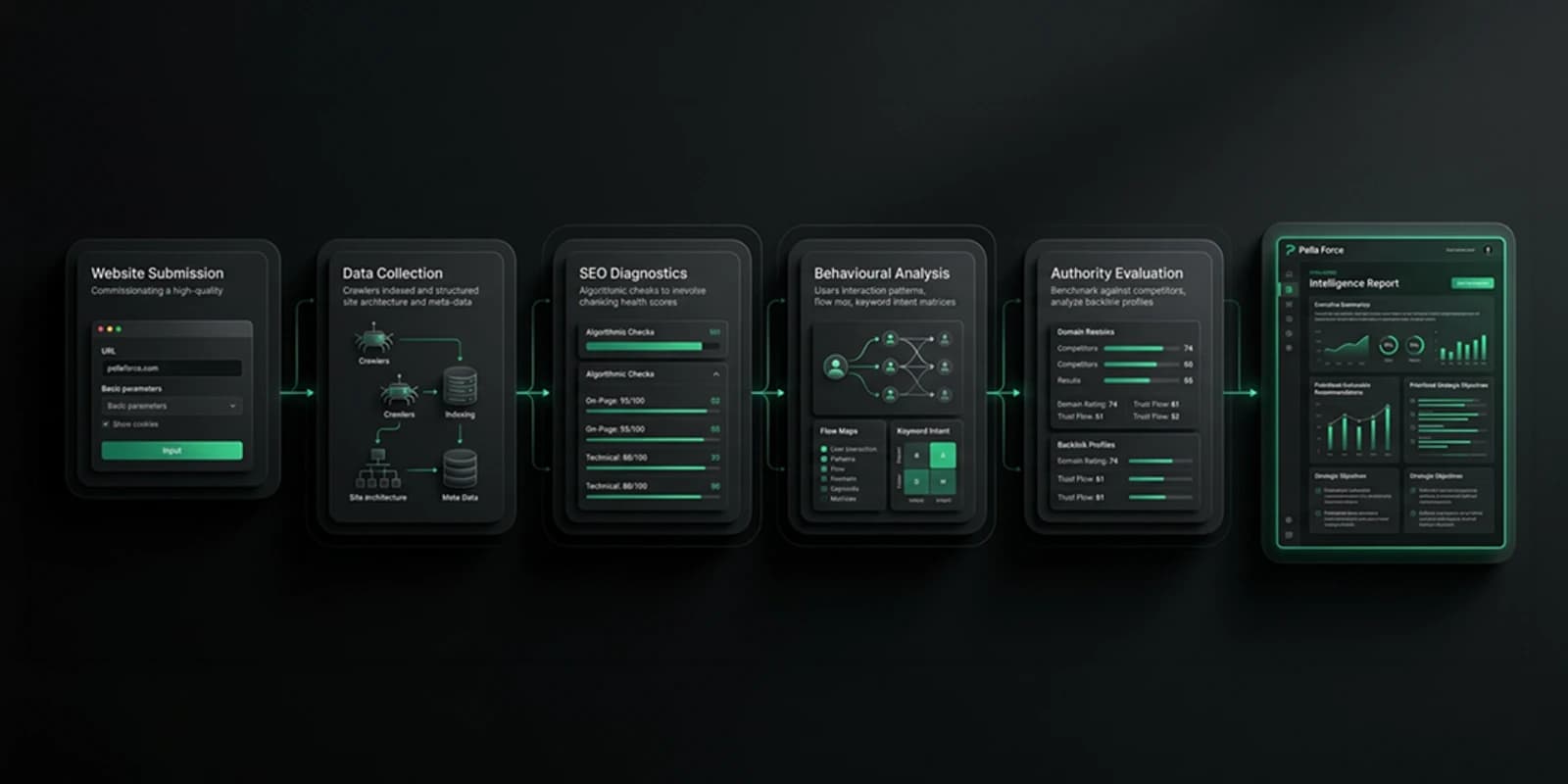
Understanding Market Trends Through Digital Intelligence Insights | Pella Force
Digital Intelligence: How to Read Market Shifts Before They Reach Your Business
Posted 2/12/2026
11 min read
A
By Atul Lohar
How Digital Intelligence Helps Brands Detect Market Shifts Before They Happen?
Markets rarely change abruptly. At first, changes can be barely noticed through altering search patterns, different ways of content engagement, and changing audience conversations. Brands that depend solely on sales data or surface-level metrics often see the change only after it has already affected their performance.
Digital intelligence provides a way for brands to sense movements even before they happen. Through the analysis of behavioural clues, changes in sentiment, and structured reporting insights, companies understand better where people's attention is going. They can also change the perception of the audience, and what kind of strategic moves they need to make to stay in front.
Using Search Behaviour to Track the Market
Quite often, one of the earliest signs of market movement is search behaviour. When audiences start to know about newly involved topics, looking at alternatives, or going deeper into the information, search patterns will show that curiosity even before a category shift at the level of a whole market becomes visible. These first signals are a window into changing consumer expectations and the development of new demand areas.
By studying the rising topics, changing ways of asking questions, and shifts from informational to evaluation, driven intent in searches, brands get a sneak peek into future audience interests. This layer of behaviour, therefore, assists in anticipating and aligning one's positioning with what's gaining traction.
Understanding Audience Behaviour Across Platforms
Audience intent is usually developed in multiple digital channels. Social platforms, websites, content hubs, and search engines all contribute to giving signals that reflect how interests and comparison behaviours evolve. Looking at these different channels together gives a better understanding of market dynamics.
Cross-platform analysis provides a view of the audience journey from the recognition stage to the depth of knowledge. The themes of engagement, the paths of content navigation, and the frequency of interaction are the indicators of how confidence is gradually built. In their totality, these signals can reveal the broad trend of the market and the evolution of the category.
Perception is one of the most important factors in determining the direction of the market. Sentiment signals across digital environments show brand, category, and expectation emerging from the point of view of the audience.
Conversation Themes
The topics of discussion that come up regularly in conversations attract the most attention, value, or prioritise of the audiences. These themes open a window to the future where decision, making criteria and expectations are changing.
Trust and Credibility Signals
References to one's knowledge, openness, or trustworthiness are indications of how confidence goes up in a category. Following these signals visually presents the change in perception over time.
Experience Narratives
Experience stories and patterns of feedback disclose satisfaction levels and emotional bonds. They drive market movement and also influence the extent to which they spread.
The Role of Structured Reporting in Market Understanding
Raw data by itself adds to complexity, whereas structured reporting provides clarity. Systematised intelligence turns the numerous scattered emitters of digital signals into a meaningful strategic direction for the company.
Pattern Recognition
Structured analysis ensures disclosing repeated behaviours and correlations between different platforms. Therefore, it allows us to get market signals that are really consistent.
Signal Prioritisation
Data is arranged according to its relevance and impact so that the main focus can be kept on those insights which are able to determine strategic outcomes.
Strategic Interpretation
Reporting uses behavioural and competitive information as a basis for clear explanations that can be used for decision-making and long-term planning.
From Data to Strategic Foresight
Simply gathering data rarely benefits. The true worth is in the way of connecting the search behaviour, engagement patterns, and sentiment signals into one intelligence framework. When these three are examined as a set, it becomes clear how awareness develops, how interest grows, and how the criteria for making a decision change.
This complete picture gives brands the power of foresight rather than the necessity to react. Rather than changing a strategy only when a drop in the performance is detected, companies can directly align their marketing messages, product positioning, and content plan. Hence, this method of staying ahead of the curve over time leads to an increase in the company's competitive advantage. Along with this, it also grows its ability to withstand unexpected changes on the market.
Why Early Detection Gives Brands the Edge
Brands that spot changes early get more options. For example, they can fine-tune their content strategy before the general public notices the new patterns. They can decide on a different angle of product communication when the evaluation criteria seem to be leaking out. Also, they can build their status in those areas where public interest is steadily growing.
Besides, early insight lessens the possibility of mistakes. Instead of investing heavily in the areas where public interest is fading, a company decides to focus on the sectors that are booming. Such a switch of focus makes a company more productive.
Digital intelligence, thus, fundamentally changes the company's way of market watching from a mere reactivity to a highly proactive strategy.
Conclusion
It is very important to note that understanding market movement requires more than periodic analysis., You need to keep a tab on the pulse of developments in the entire ecosystem. It includes monitoring search trends, cross-platform behaviour, sentiment changes, and structured reporting insights. When these signs are gathered, projected and analyzed together, the true picture of what is driving people on the market is finally revealed.
Brands turning to digital intelligence are able to act clearly and confidently. They keep growing in the world constantly changing around them. At Pella Force, we focus on quality reports using digital intelligence that businesses can use for decision-making.
Frequently Asked Questions
What is digital intelligence and how does it help understand market movements?
Digital intelligence is the strategic use of data analytics, AI, and real-time digital signals to interpret market behaviour and trends.
Aggregates data from social media, search trends, web traffic, and financial indicators
Translates raw digital signals into actionable market movement insights
Enables businesses to detect emerging market shifts before competitors
Supports data-driven decision-making with predictive and descriptive analytics
Helps brands respond to consumer sentiment and industry disruptions in real time
How do businesses use digital intelligence to track market shifts?
Businesses use digital intelligence platforms to continuously monitor and analyze data streams that signal evolving market conditions.
Track search volume trends, social listening data, and competitor activity
Use AI-powered dashboards to identify anomalies indicating market movement
Analyze customer behavior changes across digital touch points
Monitor industry news, regulatory changes, and macroeconomic signals
Integrate CRM and web analytics data for a unified market intelligence view
What are the key components of a digital intelligence strategy for market analysis?
A robust digital intelligence strategy for market analysis combines technology, data sources, and analytical frameworks.
Data collection: Web scraping, APIs, social listening, and search analytics
AI/ML models: Predictive analytics and pattern recognition for trend forecasting
Competitive benchmarking: Tracking rivals' digital footprint and positioning shifts
Real-time dashboards: Visualizing market movement indicators dynamically
Actionable reporting: Converting intelligence into strategic business decisions
What tools are used for digital intelligence in market movement analysis?
Leading digital intelligence tools help organizations capture, process, and interpret market signals effectively.
SEMrush / Ahrefs: Track keyword trends and search demand shifts
Brandwatch / Sprout Social: Monitor social sentiment and consumer behavior
Why is real-time digital intelligence critical for detecting market shifts early?
Early detection of market shifts gives businesses a decisive competitive advantage in rapidly changing environments.
Real-time data reduces the lag between market change and business response
AI-powered alerts flag anomalies before they become macro-level disruptions
Continuous monitoring of digital signals identifies micro-trends as they emerge
Enables agile strategic pivots rather than reactive, delayed decision-making
Reduces risk exposure by anticipating demand changes, competitive moves, or regulatory shifts
How does AI-powered digital intelligence improve market movement forecasting?
AI enhances digital intelligence by enabling predictive modeling that goes beyond historical trend analysis.
Machine learning models identify non-obvious correlations between market signals
Natural language processing (NLP) analyzes news and social content for market sentiment
Predictive algorithms forecast demand curves and consumer preference shifts
AI reduces human bias in interpreting ambiguous market movement data
Continuously self-improves as new market data feeds into learning models
What is the difference between market intelligence and digital intelligence?
While related, market intelligence and digital intelligence serve distinct but complementary strategic purposes.
Market intelligence covers broad competitive and industry landscape analysis
Digital intelligence focuses specifically on data derived from digital channels and platforms
Digital intelligence is faster, more granular, and continuously updated in real time
Market intelligence includes offline sources; digital intelligence is data-native
Together, they create a comprehensive, 360-degree view of market movement and shifts
How can digital intelligence identify emerging market opportunities?
Digital intelligence surfaces hidden market opportunities by connecting patterns across disparate data sources.
Rising search queries signal growing consumer demand before mainstream adoption
Social media trend analysis reveals underserved audience pain points
Competitor traffic analysis exposes market segments they are beginning to target
App store and e-commerce data reveal product category momentum
Keyword gap analysis uncovers untapped topics and niche market entry points
What industries benefit most from using digital intelligence for market shift analysis?
Digital intelligence delivers the highest ROI in industries with fast-moving competitive dynamics and digital-first consumer behavior.
Retail & e-commerce: Real-time demand forecasting and inventory optimization
Financial services: Stock movement prediction and risk signal detection
Healthcare: Patient behavior trends and pharmaceutical demand shifts
Real estate: Property demand mapping and investment opportunity identification
Technology & SaaS: Competitor product shifts and feature adoption trends
Digital marketing agencies: Client industry trend tracking and content positioning
How does digital intelligence support competitive strategy during market disruptions?
During market disruptions, digital intelligence acts as an early warning system and strategic compass for businesses.
Monitors competitor responses to disruptions in near real time
Tracks shifts in consumer sentiment and purchasing intent
Identifies which market segments are growing or contracting during disruption
Enables scenario modeling to prepare multiple strategic response options
Supports crisis communication strategy based on real-time audience sentiment data
What is the role of predictive analytics in digital intelligence for market forecasting?
Predictive analytics is the core engine that converts historical and real-time data into forward-looking market forecasts.
Uses statistical models and AI to predict future market movement based on past patterns
Combines internal business data with external digital signals for holistic forecasting
Reduces uncertainty in strategic planning by quantifying probable market scenarios
Enables dynamic pricing, demand planning, and product launch timing optimization
Improves forecast accuracy with each new data cycle through machine learning
How do you measure the effectiveness of a digital intelligence program for market analysis?
Measuring the ROI of digital intelligence requires clear KPIs aligned to business outcomes.
Speed to insight: How quickly market shifts are detected vs. industry average
Decision accuracy: Improvement in forecast-based decisions over time
Competitive win rate: Business outcomes tied to intelligence-driven strategies
Data coverage: Breadth of monitored digital channels and signals
Alert precision: Ratio of actionable signals to false positives generated
What is digital market intelligence and how does it differ from traditional research?
Digital market intelligence replaces slow, periodic traditional research with continuous, automated digital data collection and analysis.
Traditional research: Surveys, focus groups, delayed industry reports
Digital intelligence: Real-time social listening, web analytics, and AI trend analysis
Digital intelligence scales globally across unlimited data points simultaneously
Provides 24/7 monitoring vs. point-in-time snapshots from traditional methods
Enables hyper-personalized insight versus broad demographic generalizations
How can small businesses leverage digital intelligence for market shift detection?
Small businesses can access powerful digital intelligence capabilities through affordable, scalable tools without enterprise budgets.
Use Google Trends and Search Console for free demand signal monitoring
Leverage SEMrush or Ubersuggest for competitive keyword and content shift tracking
Monitor brand and competitor mentions via free social listening tools like Mention
Analyze audience behavior through Google Analytics 4 behavioral reports
Use AI tools like ChatGPT or Perplexity for rapid market research synthesis
What data sources feed digital intelligence platforms for market movement tracking?
Comprehensive digital intelligence platforms synthesize data from multiple source categories for maximum market visibility.